
Which One Should I Use, Part VIII (Preamble)
Are we up to Part 8 already? Time sure flies, doesn’t it. Those of you who know me or have read other articles of mine, know that I travel a lot for ACT (Advanced Control Technologies, Inc.). I enjoy traveling, as long as it isn’t every week. Back in January I spoke at the big CES convention (Consumer Electronics Show) in Las Vegas.
Then, in early February, I was asked to speak at the Home Automation Association convention in Orlando Florida. The HAA convention is only a fraction of the size of CES but since its purpose is only HA, it is a great convention. All my friends in the HA community were there. As last year, it was held at the Orange County Convention Center on the southwest corner of Orlando.
If you didn’t attend, plan to do so next year. You can meet us at the convention while the rest of your family goes to Disney World, Sea World, Universal Studios or whatever. You will have a great time. (As far as we teachers are concerned, that convention center is also a great place to teach a class. They have the best arrangement for classrooms plus they have great A.V. equipment.)
Okay, what are we going to discuss in this chapter? At the end of the last section, I gave you the chance to vote. Depending on your votes, the next episode would be, “3- & 4-Way Troubleshooting”, or “Noise and Filtering”, or “The Basics of the X-10 Binary Codes” or I even gave you the option of suggesting your own topic (kind of a “write-in” vote). I received a lot of email for “3- & 4-Way Troubleshooting”, a lot for “Noise and Filtering”, none for “The Basics of the X-10 Binary Codes” plus one write-in for “Whole House Filtering”.
Then my email died. We here at ACT had to move our internet server. We had been contracting for our web site ( http://www.act-solutions.com ) on someone else’s system but we had to move it to another site. Eventually we hope to have it in our own building. For almost three weeks (late February, early March) our web site was down as well as my internet email.
I was forced to make a decision on the subject of this chapter even though I was unable to read any more email votes. When my email died in late February, the votes were slightly in favor of finishing up 3- & 4-ways, so that is what I started writing. Although this may sound like voter fraud, this one is entitled:
Which One Should I Use, Part VIII
(Troubleshooting Three-Way and Four-Way Switch Circuits)
Four months ago we began (what was thought to be) a two part series on 3-way circuits but obviously it has turned into a three-parter. Back in February I left you with these questions:
- Can I use the slave switch any differently than the examples already given?
- Why do some light bulbs just not work with 3-ways?
- My new X-10 3-way will come “on” okay, but why can’t I turn it “off”?
In this section I will try to answer those plus a few others, but I caution you, if you are wanting to troubleshoot your 3- or 4-way X-10 circuit, please do not start reading here. You need to get a good foundation of how standard 3-ways work and how the many variations can be converted into X-10 3-ways. To do that you must go back and read the “Which One Should I Use, Part VI”, and “Part VII”. There are of course, five more articles before those and while each is a masterpiece in its own right, only parts 6 and 7 have anything to do with 3-ways.
(Interesting note: Experienced web surfers have a strange vocabulary and often invent acronyms for commonly used phrases. One reader emailed me and referred to the last chapter as “WOSIU-#7”. I have to admit, that is a lot shorter than “Which One Should I Use, Part VII”.)
You may recall from the last part, that I said that we get a lot of technical calls on 3-ways (and I don’t mean the kinky kind). It is common to find that the installer doesn’t understand standard 3-way circuits, let alone X-10 3-way circuits. Perhaps it is two light switches at the ends of a long hallway or at the top and bottom of a stairway. A 3-way circuit has the ability to control one load from two different locations.
We intuitively know that a light switch that is “down” is usually “off” and one that is “up” is usually “on”. You may have never noticed, however, that the special switches made for 3-way circuits do not have the familiar “on” and “off” embossed into the plastic. That is because “on” can be up or down, depending on the position of the other switch.
Things to consider: (I have already given this in both of the previous parts so let’s do the Cliff Notes version.)
- In a standard 3-way, the current flows through both switches but in an X-10 3-way, the current flows only through the 3-way master.
- A standard 3-way can not be converted to an X-10 3-way circuit just by replacing one switch.
- I call any dimmer receiver a “2 wire” dimmer if is designed to work without a neutral connection. I call it a “3-wire” dimmer If it’s requires a neutral. All relay receivers require a neutral wire.
- Most importantly, all electrical work should be done by a qualified and licensed electrician adhering to all national and local electrical codes. Although circuit breakers are not shown, appropriately sized breakers are required on all circuits. And never use the ground wire for anything other than ground!
Okay, lets talk about some basic troubleshooting concepts. We must assume that first and foremost, your X-10 based 3-way installation was done correctly according to the wiring instructions that came with your unit. Second, you have the proper test equipment (multi-meter, etc.) and experience to know how to install it and if you don’t, you had a qualified electrician or HA installer do it for you. This may be beating the proverbial dead horse but we occasionally get calls from people needing “troubleshooting” help when they didn’t even read the instructions.
We must also assume that your existing wiring is sufficient for the chosen X-10 device. That means that if you have chosen a 3-way master that requires a neutral, you must have a neutral in the wall box (and I don’t mean “ground”, I mean a real honest to goodness “neutral”). Finally, we must assume that the X-10 receiver is an otherwise properly operating unit. I have seen an installer mis-wire a receiver, burn it up, and then want troubleshooting help. Now that we have that out of the way, lets move on to some not-so-obvious troubleshooting considerations.
1. Can I use the slave switch any differently than the examples alreadygiven?
Why, yes you can (sometimes). Since I always like to give credit where credit is due, it was Charles Sullivan (cwsulliv@nr.infi.net) who reminded me about something in residential 3-ways that I had omitted. Since I deal mostly with industrial/commercial installations, most of my 3-ways problems relate to relay receivers and many of those are on 277v circuits. I often forget that the basic “mail-order/buy-it-from-a-catalog/Radio-Shack/type-o’-stuff” X-10 based 3-ways are of the 2-wire variety and they are a bit more flexible as far as their wiring. One piece of warning, however, do not try this on any relay receiver.
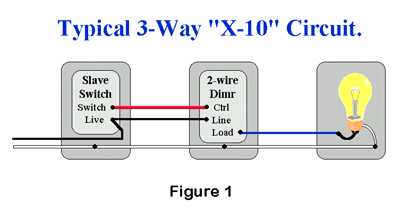 Figure 1 shows a typical X-10 based 3-way circuit. It has a standard “2-wire” dimmer receiver. (Yes, I know the control wire makes it a total of 3 wires, but you know my rules. If you don’t, then you need to go back and read WOSIU-#6 and WOSIU-#7.) This arrangement shows the slave switch in the first wall box. (Some people prefer the more politically correct term “auxiliary” switch, but… ) Usually, the slave switch is used to connect line voltage to the control lead of the 3-way master receiver. (I made the word “control” in red, not to designate a hyperlink, but to show that the control lead is usually red in color.)
 But, that is not the only way the slave switch can be used. Figure 2 shows an alternate method. Since the master receiver is looking for a “change in voltage”, that change can be up or down. If you have ever used a multi-meter to measure the voltage on the control lead, you may have noticed that there was already voltage there even when it wasn’t wired up to anything. Figure 2 shows how the slave switch can be used to connect neutral to that control lead instead of line voltage. “Sometimes” this may work better for you, it all depends on other factors which neither you nor I could possibly know until you try it.
By the way, if you do try to measure the voltage on the red control lead while it is connected to the slave switch, you will also notice how difficult it is to do. The very presence of the multi-meter sometimes effects the operation of the 3-way master. When you press the button on the slave, you may see almost no change in voltage and the master doesn’t seem to react. Remove the multi-meter and everything works fine. That’s just part of the wonderful world of troubleshooting.
 Okay, here’s another variation (figure 3). If you were forced by the availability of wires in the wall boxes to place your 3-way master in the first box and the slave in the second one, you will discover that there simply are not enough wires to get line voltage to the slave. In this case using the neutral wire is a viable option.
 Finally, figure 4 illustrates one more possibility. According to most instruction sheets for the actual X-10 PowerHouse 3-ways, the slave switch is shown as being wired between the load and the control leads of the master receiver in many instances. (None of ACT’s 3-ways show this as an option. I also don’t think any of Leviton’s units show it as an option either, but since I don’t work for Leviton, I’m not willing to bet any Peanut M&M’s on it.) So if you are using something other than standard “buy-them-from-a-catalog-or-from-Radio-Shack-or-hardware-store-type-of-X-10” units, then don’t try this. Always consult the instruction sheets that come with your unit.
All of these diagrams show the minimum of wires but we all know that in many instances there may be bundles of wires for several circuits in multi-ganged wall boxes. Here are a few points that are good to know:
- In most cases, it is better to use the same line for the master and the slave. Even though it may seem trivial, using a line wire from one circuit on the master and a different line wire from another circuit for the slave may cause a problem. Sometimes only a 1 or 2 volt difference can result in an unreliable 3-way operation. If the two circuits are actually from opposite sides of the panel, you could even have a very dangerous 240v instead of 120v. While this is rare, it is possible. Electricians try very hard to make sure that only one phase is present in multi-ganged wall boxes.
- The same thing is true for the use of neutral wires. If your are using a 3-wire dimmer or a relay receiver, then it will require a neutral connection. That neutral should be the same one that goes to the load. Using a different neutral can also cause a few volts of difference and result in an unreliable system.
2. Why do some light bulbs just not work with 3-ways?
This was covered a little in previous articles but it certainly won’t hurt to cover it more thoroughly in this one. In actuality, the same bulbs (and other loads) that cause problems for 3-ways, also cause problems for standard receivers.
First consider what type of 3-way master you are using. A 2-wire dimmer receiver is far more fickle about what it wants to control. Remember, a 2-wire dimmer gets its operating power and its signal through the load. (If that statement is confusing, you should go back and read the very first part of this series). What if the load you are trying to control does weird things to the power? …or blocks the X-10 signal? There are light bulbs that do that.
Several years ago, Sylvania came out with a line of energy efficient bulbs called “Capsylite” bulbs. They actually have a capacitor and a diode built inside. When these bulbs (mostly used for flood and spot light applications) first came on the market, we in the X-10 biz really started scratching our heads.
Most of us knew that these bulbs were bad news (at least when we tried to control them with X-10 receivers) but we may not have known why. If you have one of these bulbs, or suspect that you do, you can use your ohm meter to check it. With the bulb out of its socket (no power, obviously), use your ohm meter to test for the resistance of the bulb.
With the test leads connected one way, it will show nearly a dead short, but reversing the leads will show an open. That is because there is a diode inside the bulb. Actually, there is also a capacitor so when you do this test you may see an odd indication on your meter. Depending on which way you have your leads (and there is no way to know before hand) you may see a short circuit.
That little battery in your ohm meter also charges up the small capacitor in the bulb so that when you reverse the leads, you will see an instantaneous reversal of your analog needle. It may “peg out” in the wrong direction. If you are using a digital meter, it will show a momentary presence of voltage until that capacitor discharges, then it will slowly go to an open in a second or so.
So what do these bulbs do to X-10 dimmers? Weird and strange things, children! (Perhaps HTI should have a contest for the strangest thing you have ever seen with these bulbs.) As a rule, we just don’t recommend trying to use an X-10 dimmer with Capsylite bulbs or any other brand that has similar characteristics (GE Miser, etc.)
The only type of bulbs that should be used are the regular, run of the mill, garden variety, grocery store type of incandescent bulbs. And by the way, make sure you stay under the 500w dimmer rating.
Another type of “light” that should not be used with X-10 dimmer receivers (3-ways or not) are fluorescent lights. That means the big units (4-foot, 8-foot, round ones, curved ones, etc.) and the little screw-in ones. Those new little ones are commonly called “CFL’s” for “Compact Fluorescent Lights”. Since they are “ballasted” they are in the category of non-linear loads.
Even though there are a few exceptions to the rule, I still recommend that you never try to control a fluorescent light with any electronic dimmer unit (which includes X-10 dimmers). While it is true that there are a few fluorescent ballasts on the market that are designed for use with dimmer input, they are rare.
Another ballasted light is the HID (High Intensity Discharge) class of lighting. We usually think of Sodium Vapor lights as being in this category but there are many others. In any event, since they use a ballast, they are an X-10 dimmer no-no.
Many sources of X-10 information have also placed Halogen Bulbs on the no-no list but that is because many people don’t know the difference in “low-voltage” halogen and standard 120v halogen. If the bulb is a standard, 120v bulb with no “built-in” transformer nor power-supply, then an X-10 dimmer should work just fine.
On the other hand, any kind of low voltage bulb means that it must have a step-down transformer or low-voltage power supply and so it is on the no-no list. (There is a subject for whole article. Perhaps “Which One Should I Use, Part IX, Low-Voltage and Halogen lights”.)
A 3-wire X-10 dimmer (like ACT’s RD161 which requires it’s own neutral connection) can often be used with non-linear loads where a 2-wire dimmer simply will not work For more information on that refer back to WOSIU-#2 which talks about controlling transformers and motors. I
n almost all cases, a relay receiver will be able to control any load. I say “almost all cases” because some CFL’s and some power supplies for low-voltage lighting generate so much electrical pollution that the X-10 signals can’t get through. (There is a subject for whole article. Perhaps “Which One Should I Use, Part IX, Noise and Filtering”.)
3. My new X-10 3-way will come “on“ okay, but why can’t I turn it “off“?
One of the very first lessons a good troubleshooting technician learns is to be sure he understands the problem. The problem of “On but not Off” may be one problem disguised as another problem. First, let’s talk about the “signal” problem, and then the “3-way” problem.
If you can send an “on” command and have the light come on, but discover that sending an “off” command does nothing, it may be a signal strength problem and not a “3-way” problem. This is almost always found when using a 2-wire dimmer (either a single or a 3-way master) which gets its power and its signal “through” the load. Incandescent filaments have a positive temperature coefficient which means that the resistance of the bulb increases as its temperature increases. When it is cold (off) a marginal signal will still be able to squeeze through.
Once the bulb is hot (on) the signal has a much harder time getting through to the 2-wire X-10 dimmer receiver. If this is the case, the presence of the slave switch has nothing to do with this but since this problem occasionally arises with the installation of a 3-way dimmer circuit, some people think there is a problem with the receiver. This is a low signal problem and can be corrected by proper coupling.
 The other “On but not Off” problem really is a “3-way” problem. Look at this diagram (figure 5) and you will notice a circle around the travelers. “Travelers” is just a term that means the wires between the slave and the 3-way master. Although my drawing shows them as only a few inches apart, in reality the wire runs may be a very long distance. When the load (in this case the light on the right) is off, there is just enough current flowing through the line wire to keep the 3-way master working. As soon as the light comes “on”, the amount of current increases dramatically.
That increase in current also will increase the induced voltage in the control lead. That means that when you press the slave switch, the light will come on. Then, unknown to you, the increased current has induced a constant voltage onto the control wire. Even though you have removed your finger from the slave switch button, a small amount of voltage remains. When you again press your finger on the slave switch button, nothing happens.
I have seen this in varying degrees of complexity. Sometimes the voltage is borderline and causes only an occasional problem. Sometimes this only becomes a problem when the home owner replaces the light bulbs with higher wattage ones. That small increase in current makes a previously reliable 3-way into an unreliable one. Sometimes the current on a nearby circuit (in the same multi-ganged wall box) causes the problem.
And then, every once in a while, an installation will have the induced voltage that is so high that once it is turned on, the dimmer continuously cycles from dim to bright, over and over endlessly as if there were some invisible finger still pressing on the button.
Okay, how do we fix this? Well, that depends. We at ACT have our slave switches manufactured with a .01m fd capacitor inside them. As a matter of fact, that is the only electronic component in a slave switch. Other companies may not have a capacitor in their slave switches (but as I said before, I only work for ACT so I wouldn’t bet any M&M’s on it, one way or the other). That little capacitor helps with impedance matching and so induced voltage is less of a problem.
If you are a DIY’er and are experiencing this problem, simply changing to an ACT slave switch will sometimes correct it. Or if you would like, sometimes you can add a .01m fd capacitor where the slave connects to the travelers. Since this is an “add-on” I would not recommend doing this if it conflicts in any way with your local electrical codes.
Another tactic is to rearrange the order of the devices or the wires they are using. That means that if the required wires are present to allow it, simply swap the positions of the master and the slave. Also, if your installation is using a 2-wire dimmer you may try using the slave on neutral or load instead of line (as discussed above).
 Lastly, when all else fails, sometimes the only thing you can do is to abandon the use of a true 3-way slave and install a wall mount transmitter (figure 6). Now please don’t misunderstand. This is not “giving up”. This simply means that in some cases it is more time efficient and cost effective to use a transmitter than to continue to try and figure out why there is an induced voltage on the control lead, or a higher than normal neutral voltage.
We in the commercial/industrial automation side have an advantage since we can often fish a new neutral wire or control wire through a conduit. In HA you are often stuck with the wires you have. Your customer will get mighty torqued off if you start sawing through his wall to run more wires. Just remember, a transmitter uses line and neutral, not the control lead.
 One more strange wiring scenario before we put this episode to rest. Figure 7 shows an “illegal” circuit. This is a overly simplistic wiring diagram and in reality it can be done in several different (yet still illegal) ways. No matter how you look at it, it’s is illegal because its dangerous. With one switch up and the other switch down, the circuit is complete and the light comes on.
With both switches down, there is no voltage at the light and it goes off. With both switches up, however, the light is off, but there is a shock hazard because both of the wires now have 120v present. Not a good idea. At a recent class, I was handed a drawing with this basic diagram. It was referred to as a “French” 3-way. (I had never heard of it, French or not.)
If you ever run into such a 3-way circuit similar to this, please do not try to convert it to an X-10 3-way. The larger priority is to update the circuit to an electrically safe, National Electrical Code approved 3-way circuit. Then you can convert it to an X-10 3-way.
As usual, I am writing this at the last second and so I need to proof it and send it off to Bob Hetherington at HTI. Apparently I got it in to him in time, otherwise you wouldn’t be reading this, now would you. The next chapter (June 1998) we will again be open to the will of the masses I would like your opinion on the following choices:
Noise and Filtering.
X-10 Binary Codes Including the New Extended Code.
General Troubleshooting and Test Equipment
You are going to have to let me know what you want, however I will only take votes until the middle of May. You know what they say in politics: Vote soon and vote often! Cast your vote through email: pkingery@act-solutions.com
Oh, one more thing. ACT is hosting its next 2-day X-10/PCC technical class here in Indianapolis on May 14-15. Since the first day of qualifications for the Indianapolis 500 is on Saturday the 16th, we suspect it will fill up fast. Email me for more information.